Maastricht and Valkenburg, Limburg Region, Netherlands
Hello dear readers and future travellers. In this post I shall be recalling my visit to the Netherlands, a first for Travel Troves. I have visited the Netherlands and neighbouring Belgium many times. Together with Luxembourg, they form the Low Countries – named and famed for their flat landscapes and canalised cities. However, there is a region of the Netherlands which isn’t as flat as a pancake (or stroopwafel). This is the Limburg region, the Netherlands’ southern-most and hilliest area. You may have seen it on maps of the Netherlands: the elongated strip sandwiched between Belgium and Germany.
Most people bypass the Limburg region. It’s a pity as there are plenty of hidden gems here. I explored quaint towns with cobbles and canals, minus the crowds of Amsterdam.
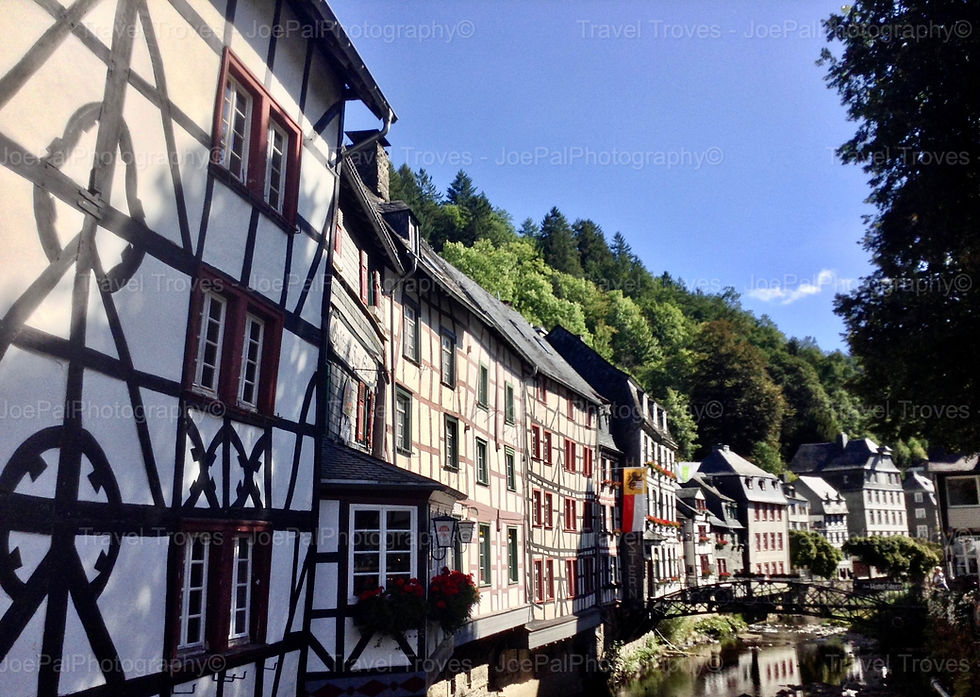
Maastricht and Valkenburg are the best places for this and are the focus of my article. I roamed rolling hills with charming castles and leafy lanes, ideal for cycling or walking the Mergellandroute. You can also visit three European countries whilst here: the Netherlands, Belgium and Germany. I thus combined my stay with a cross-border visit to Germany’s Aachen and Monschau.
How to get here
Maastricht is the Limburg region’s capital. It has an airport (a small one) and a well-connected train station with regular links to Amsterdam, Liege in Belgium, and Aachen and Cologne in Germany. The Netherlands’ compact size means you can arrive anywhere and reach your destination in the same day.
Larger airports include Amsterdam’s Schiphol, Brussels in Belgium and Cologne or Dusseldorf in neighbouring Germany.
I’ve visited Maastricht and Valkenburg twice, once on a coach tour in 2019 from North East England. This was an abysmally 20-hour long journey, mainly stuck on the M25 around London and waiting for the Dover-Calais Ferry crossing. The coach driver had BBC Radio 2 on full blast. Thank God for ear plugs! The Dover-Calais Ferry was strangely quiet. There was practically no one on board. It felt like a ghost ship; the Mary Celeste with duty free. I think people were avoiding the Dover ferry at this point because of the Brexit uncertainty in 2019. The coach proceeded through Belgium’s Flanders Fields, skirting Brussels where I briefly saw the Atomium monument from the motorway. Our tour arrived at nearly midnight. I was not a happy bunny.
A better experience for me was getting the DFDS ferry from Newcastle to Amsterdam (Ijmuiden). I went with my family and travelled by car just after the 2020 Covid-19 Pandemic, wanting a flight-free travel experience. This was much more manageable, and we had a leisurely 3–4-hour drive down south towards the Limburg region. The Dutch road network was much better than England’s congested, worn-out motorways. We passed several windmills on our way too. If you fancy a stop on the way down or back, visit the quaint medieval town of Zaltbommel which lies on the River Waal (both pictured above), a tributary of the mighty Rhine.
Maastricht, the Limburg Region's capital
A lively yet charming town, Maastricht has a youthful flair thanks to its university. It reminded me of Germany’s Hannover and Gottingen, even York back home in England. However, Maastricht is a worthy destination in its own right and is significant in European history. The city lies on the banks of the River Maas; go further south into Belgium and France, the Maas becomes the River Meuse. Due to its location and close links to other European countries, this Dutch city was the signing place for the Maastricht Treaty of 1992. The Maastricht Treaty paved the way for the European Union and the Euro Currency, now used in 21 of the current 27 member states. Love it or loathe it, the EU has undoubtedly brought peace and prosperity to the European continent after the Second World War and the Cold War.
Maastricht’s history as a town began in the Roman era when a bridge was constructed over the river in the first century AD. Even after the Roman Empire fell, Maastricht prospered during the reign of Charlemagne (King of the Franks from 768-814). This was due to its close proximity to the German city of Aachen, which was Charlemagne’s Imperial Capital. You can see Maastricht’s medieval past with the Romanesque Cathedral of Saint Servatius, a key pilgrimage site, and the adjacent Gothic Saint Jan’s Church.
If you can’t get enough of medieval Christian architecture, head to the nearby Dominican Church. You won’t find holy reliquaries in here, but instead lots and lots of books. That’s because the Boekhandel Dominicanen is located in this 13th Gothic Church. It is bookshop heaven! Dutch and English titles are stocked here as are various genres. Although it can get very busy, it was my favourite place in Maastricht. If you visit, look up and marvel at the ceiling, where there are paintings from 1619 by Jan Vassens and a 1337 mural of St Thomas Aquinas; it is the oldest church mural in the Netherlands.
The Jeker district of Maastricht contains the city’s most historical and photogenic landmarks. One is the Helpoort, a gate tower constructed in 1229; this makes it the oldest surviving city gate in the Netherlands. It wasn’t always called the Helpoort. The gate’s first name was the longer ‘Hoogbruggepoort’. I love the quirkiness of the Dutch language.
Maastricht has a thriving retail scene. There are more shops than you can shake a stick at. You’ve got big retailers alongside more niche shops like violin makers and vintage clothing.
Walking along the River Maas you see the Saint Servatius Bridge; they really love him in Maastricht. The modernised quayside reminded me of Newcastle back home in the North East albeit with less seagulls and Greggs pasties.
Mergellandroute – Eijsden and Mheer Castles
The Netherlands is famed for being cyclist friendly. If you are an active person, you might want to try the Limburg region’s Mergellandroute. This route is ideal for cyclists who want to explore the hilly region of the Netherlands. You can do the Mergellandroute by car as well and stop off and see some of the places of interest.
A must-see hidden gem is Eijsden Castle, built in 1636-37. It is a romantic, elegant structure, surrounded by a moat and adorned with striking spires. Eijsden was quiet when I visited, making it an intimate and peaceful experience. It’s quite nice to have a castle all to yourself! The Castle is situated next to the Maas River; keep an eye out for the herons. Eijsden also has a small train station which is on the line between Maastricht and Liege
If you drive or cycle further east from Eijsden, another worthy stop-off is the village of Mheer. This too has a castle, with equally charming features like turreted towers. Mheer has a relaxing café and restaurant which served a tasty yet filling burger and chips: Café Quanten.
Valkenburg aan de Geul
A small town just to the east of Maastricht, the Limburg region’s capital, Valkenburg is popular with Dutch tourists. The small Geul river runs through here, feeding into the Maas. With a canal and charming pedestrianised streets, Valkenburg is quintessentially Dutch. The restored Geulpoort tower is a must-see landmark.
Valkenburg has a castle, albeit in ruins. This is because in 1672, William of Orange ordered his troops to destroy the fortress so it wouldn’t fall into the hands of his rival, the French King Louis XIV. Valkenburg Castle was strategically important as it was the only castle in the Netherlands to be built on a hill.
Valkenburg witnessed conflict again during World War II (1939-45). The Nazis occupied the Dutch town for four years. When the American Army arrived in 1944, a fierce battle was fought here against the Nazis. The allied American force won, but Valkenburg was severely damaged. Informative billboards dotted around the town show images of the War and Liberation on 17th September 1944.
Valkenburg is a now peaceful place with plenty of attractions for the visitor. There is a modern spa, the Thermae 2000 just up the hill, alongside a state-owned Holland Casino. Yes, the Dutch have a nationalised casino. William Hill wouldn’t be happy.
You’re spoilt for choice when it comes to food, I would highly recommend the Aan de Linde restaurant which overlooks the Geul River.
Another attraction is the ‘Roman’ Catacombs. While the Romans were in this area, these catacombs are not from Roman times but are painted recreations by the designer Pierre Cuypers (1827-1921). Cuypers’ Roman-style frescoes are found in these underground caves; I thoroughly enjoyed the guided tour which was conducted both in Dutch and English. Cuypers would go on to design famous Dutch landmarks such as Centraal Station and the majestic Rijksmuseum in Amsterdam. Valkenburg’s railway station was also designed by Cuypers. It is the oldest in the Netherlands, built 1853. There are regular connections to Maastricht and Aachen in Germany from this station.
With towns and cities like Valkenburg and Maastricht, plus the Mergallandroute, the Limburg region is a Dutch hidden gem. It is the hilliest place in this Low Country and a region of many firsts in both Dutch and European history.